|
|
EDITION #17 NOVEMBER 2025
|
|
|
Hey there,
This month, the abstraction layers of AI began to solidify. The conversation shifted from "how do we build this?" to "how do we govern, scale, and trust this?" as foundational infrastructure and sobering realities came to the forefront.
Let's break it down.
|
|
|
November in review: Signals behind the noise
|
Microsoft's "Fabric" Becomes the Default Control Plane for Azure AI Services
|
What happened:
At Ignite, Microsoft announced that Azure AI Fabric is now the mandatory control and governance layer for all new AI services on Azure. It enforces a unified data lineage, security, and compliance framework across the entire AI lifecycle, from data preparation in OneLake to model inference and monitoring.
The breakdown:
This is Microsoft's masterstroke to lock in the enterprise AI stack. By making Fabric non-optional, they are positioning it as the de facto operating system for corporate AI. It directly counters the "wild west" of point solutions by baking in governance, making it easier for CISO's to approve large-scale AI deployment, but harder for companies to adopt a multi-cloud AI strategy.
Why it’s relevant:
Your AI governance strategy is now, effectively, your cloud vendor's governance strategy. For Azure shops, this simplifies compliance but demands a deep investment in the Microsoft ecosystem. For everyone else, it raises the urgency to establish a vendor-agnostic governance layer before your cloud provider does it for you.
|
The First Major "AI Supply Chain" Attack Disrupts Automotive Production
|
What happened:
A sophisticated attack targeted "ModelWeave," a popular platform for hosting fine-tuned specialized models. By poisoning a publicly available "Parts Quality Inspection" model, the attackers introduced a nearly undetectable flaw that caused assembly line robots to misclassify components. This led to a week-long shutdown at a major electric vehicle manufacturer.
The breakdown:
This isn't a traditional data breach; it's a model integrity attack. The poisoned model performed perfectly in testing but failed under specific, real-world lighting conditions. It highlights a critical vulnerability in the AI supply chain: trusting external, fine-tuned models without a verifiable chain of custody and continuous validation.
Why it’s relevant:
Every company using externally-sourced or fine-tuned models must now treat them as a critical software dependency. This necessitates robust model validation pipelines, SBOMs for AI (Software Bill of Materials), and runtime monitoring for "model drift" that could indicate compromise.
|
Apache Arrow 15.0 Released with Native Tensor and Vector DB Primitives
|
What happened:
The Apache Arrow project released version 15.0, introducing first-class support for tensors and vector data types within its in-memory columnar format. This allows data frames to natively store and process embeddings, model weights, and other multi-dimensional data without costly serialization.
The breakdown:
This is a foundational upgrade to the plumbing of the modern data stack. By eliminating the serialization tax between data processing frameworks (like Spark), ML libraries (like PyTorch), and Vector Databases, Arrow 15.0 drastically accelerates the performance of end-to-end RAG pipelines and model training.
Why it’s relevant:
For engineering teams, this is a call to upgrade. The performance gains for feature engineering and data movement between systems are too significant to ignore. It’s a key enabler for the next generation of real-time, data-hungry AI applications.
|
Anthropic's "Constitution 2.0" Paper Redefines Model Alignment
|
What happened:
Anthropic published a groundbreaking research paper, "Constitutional AI 2.0: Scalable Oversight for Superhuman Models," demonstrating a new technique for aligning models that outperform their human trainers. The method uses a recursive self-critique and improvement loop, guided by a hierarchical constitution, to achieve alignment without direct human feedback on complex tasks.
The breakdown:
We've hit the "superalignment" problem. As models become more capable than humans in specific domains, we can no longer rely on human judgment alone to train them. Anthropic's approach is a potential path forward, creating a scalable, automated process for ensuring increasingly intelligent models remain tethered to human intent.
Why it’s relevant:
This is no longer academic. For any organization building proprietary, highly capable models, this research provides a blueprint for managing the risks of superhuman AI. It moves alignment from a philosophical concern to a practical engineering discipline.
|
|
|
The Silent Crisis: Why Your "Agent-Ready" Data Isn't.
|
Last month, we celebrated the rise of dynamic AI agents. This month, we're dealing with the hangover. The biggest bottleneck to deploying these agents at scale is not compute or model intelligence, it's the shocking fragility of the data they rely on.
Agents don't just query data; they reason over it, chain operations, and make autonomous decisions. A single, previously tolerable data quality issue (a duplicate customer record, a null value in a critical field, a slightly mislabeled product category) can now cause an entire agentic workflow to fail silently or, worse, make a catastrophically wrong decision.
The "Fault-Tolerant" Data Pipeline is a Myth
Consider a "Procurement Agent" tasked with re-ordering office supplies. It's given a budget and access to your vendor database. A simple task. But if your vendor data has not been properly deduplicated, the agent might:
Identify "Vendor A Inc." and "Vendor A, Incorporated" as two separate entities.
Split the order between them, missing volume discounts.
Breach its budget by effectively placing two orders.
Your pipeline ran perfectly. Your data was "accurate" in the sense that it was faithfully replicated from its source. But it wasn't coherent enough for an autonomous agent to act upon.
The New Mandate: Coherence, with Consistency
The old data quality metrics are insufficient. We need a new benchmark for the age of autonomy: Agent-Coherence.
Temporal Coherence: Can an agent understand the state of the business at a point in time, not just the current snapshot? (e.g., What was the product catalog when this order was placed?)
Entity Coherence: Is there a single, golden view of critical entities (customers, products, vendors) that an agent can reliably use for decision-making?
Semantic Coherence: Is the business logic and taxonomy embedded in the data so explicit that an agent can't misinterpret it?
|
|
|
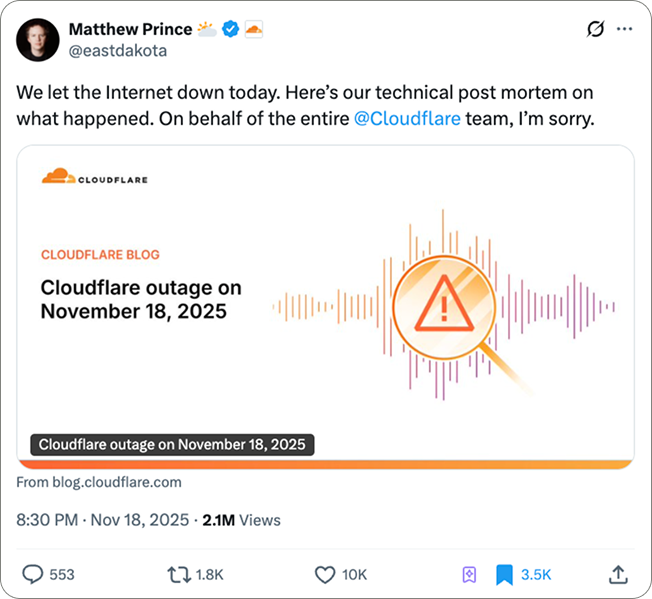
Cloudflare’s Post-Mortem
A major outage hit Cloudflare, followed by a transparent technical breakdown of what failed and why, a reminder of how fragile the internet’s backbone can be.
|
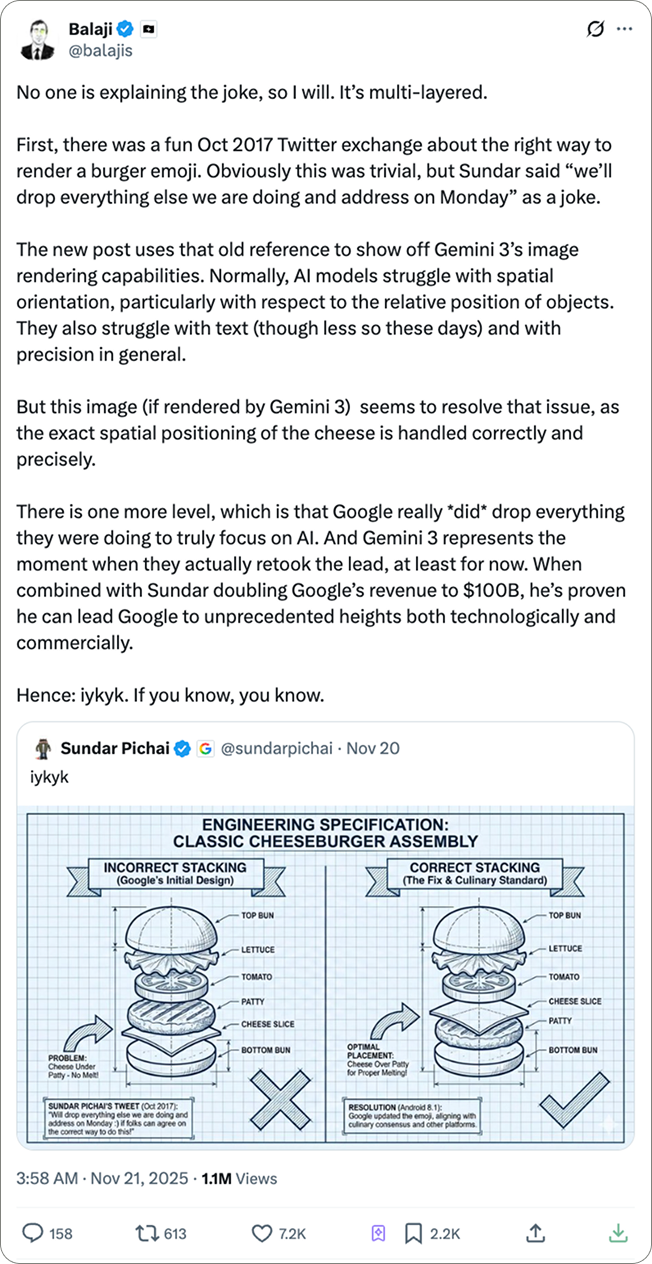
The Cheeseburger Lore
Balaji unpacked the multi-layer joke behind Google’s “iykyk” burger image, using it to highlight Gemini’s progress in spatial consistency and rendering control.
|
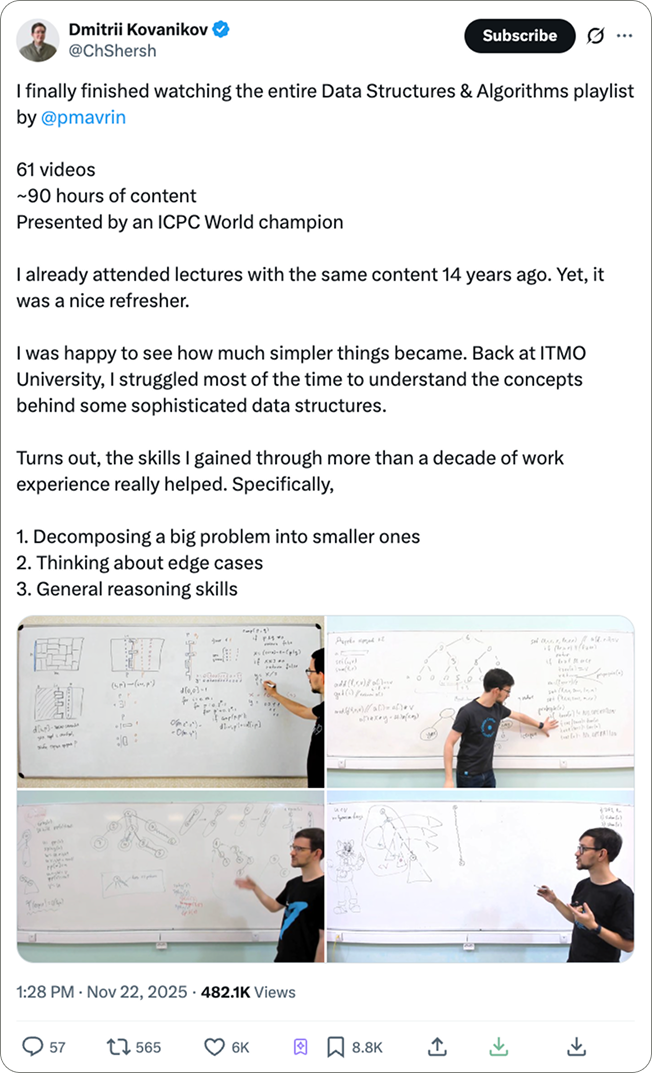
A Decade of CS Skills
Dmitrii Kovanikov reflected on re-watching 90 hours of data-structures coursework, and how real-world reasoning skills transformed his understanding of foundational CS.
|
Claude Opus Promptcraft
Anthropic shared internal lessons from testing Claude 4.5, outlining the prompting patterns that consistently push the model to its best performance.
|
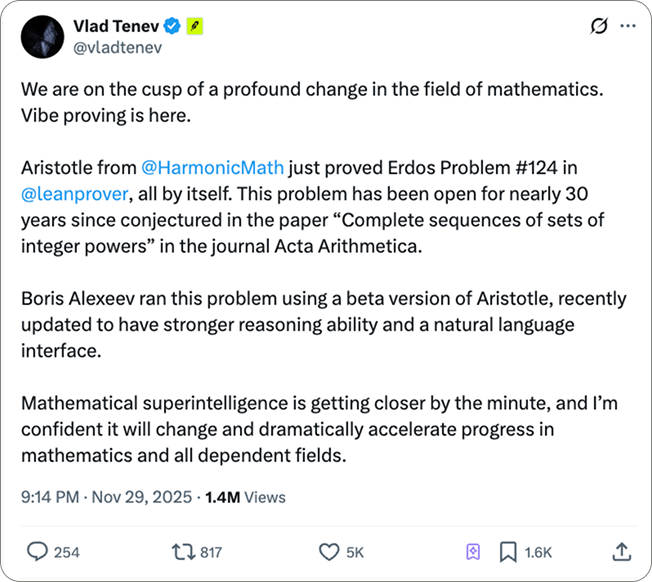
Proof by Vibe
Harmonic’s “Aristotle” system solved a decades-old Erdos problem in Lean, hinting at a coming era of mathematical superintelligence.
|
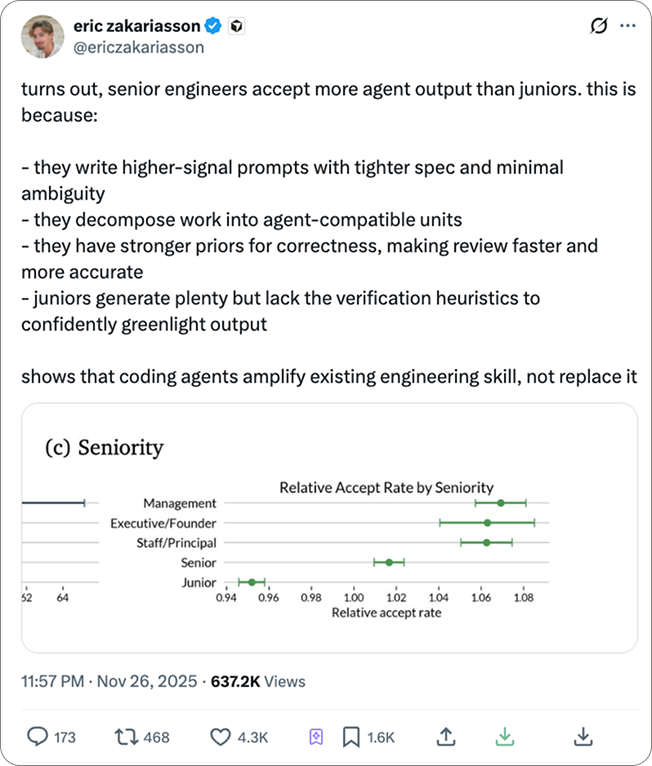
Agentic Seniority Gap
New data shows senior engineers accept far more agent output than juniors: stronger priors, tighter prompts, and better decomposition make all the difference.
|
|
|
Tools I found interesting
|
Microsoft's "Fabric" Governance Policies
Even if you're not on Azure, look at the policy templates. They represent the most comprehensive attempt to codify AI governance rules (e.g., "no PII in prompt logs") and will become the industry standard.
Anthropic's "Constitution 2.0" Paper
Don't just skim the abstract. The appendices contain practical guidelines for creating a "constitution" for your own corporate models. It's a strategic exercise for any risk-aware AI team
Termius
A unified SSH and remote-access client that simplifies managing distributed compute environments. For teams running multi-cloud clusters or on-prem GPU boxes, it brings order, security, and consistency to day-to-day ops.
|
|
|
That’s a wrap for November.
Thanks for reading.
The story doesn’t start here. Explore past editions → The Data Nomad
Quentin
CEO, Syntaxia
quentin.kasseh@syntaxia.com
|
|
|
Copyright © 2025 Syntaxia.
|
|
|
Syntaxia
3480 Peachtree Rd NE, 2nd floor, Suite# 121, Atlanta, Georgia, 30326, United States
|
|
|
|