|
|
EDITION #16 NOVEMBER 2025
|
|
|
Hey there,
This month, the industry's trajectory shifted from building isolated models to constructing intelligent, self-regulating systems. The focus is no longer just on raw capability, but on creating AI that is inherently manageable, measurable, and integrated directly into the fabric of our data platforms.
Let's break it down.
|
|
|
Snowflake Cortex Gets a "Stateful" Serverless GPU Runtime
|
What happened:
Snowflake announced the public preview of a new "Stateful" mode for its Cortex serverless GPU service. This allows fine-tuned and long-running inference jobs to maintain an active context on a GPU, dramatically reducing cold-start latency from minutes to milliseconds for complex, iterative tasks.
The breakdown:
Until now, serverless GPUs were inherently stateless, forcing a full reload for each request. This new stateful capability makes it feasible to host low-latency, high-throughput inference endpoints for custom models directly within Snowflake's data cloud. It effectively challenges the need to move data to an external MLOps platform for real-time serving.
Why it’s relevant:
The boundary between the data platform and the model serving platform just blurred further. If you're fine-tuning models on your proprietary data in Snowflake, you can now serve them with production-grade latency without any data egress. The economic and architectural case for a unified data/AI stack just got stronger.
|
The EU's "AI Act" Enforcement Begins: First Notices of Non-Compliance Issued
|
What happened:
The European Union's AI Office issued its first formal notices of non-compliance to three major tech companies for violations of the AI Act's transparency and risk-assessment requirements for high-risk AI systems in recruitment and credit scoring.
The breakdown:
This isn't a fine yet, but it's the first shot across the bow. The regulators are focusing on the lack of adequate human oversight, insufficient documentation of data provenance, and failure to conduct mandated fundamental rights impact assessments. It signals a strict, "by-the-book" initial enforcement stance.
Why it’s relevant:
If you operate in the EU or serve EU citizens, your AI governance can no longer be a theoretical exercise. The time for compliance is now. This action creates an immediate, tangible need for auditable documentation of your model's data lineage, bias testing, and human-in-the-loop procedures for any system classified as high-risk.
|
Google Cloud's "Cross-Cloud Vector Search" Goes GA
|
What happened:
Google Cloud announced the general availability of its fully-managed Vector Search engine, with a key new feature: native, high-performance synchronization of vector embeddings from data residing in AWS S3 and Azure Blob Storage.
The breakdown:
This is a direct play to become the neutral "AI brains" for a multi-cloud world. Instead of costly and complex ETL pipelines to move data into Google Cloud for RAG, the service can now directly and incrementally sync embeddings from where the data lives, creating a unified search index across cloud boundaries.
Why it’s relevant:
It dismantles a major objection to adopting a best-of-breed vector database: vendor lock-in and data gravity. You can now maintain your primary data lake in AWS while leveraging Google's state-of-the-art AI and vector search capabilities. This will accelerate enterprise-wide RAG deployment by simplifying the architecture.
|
Apache NiFi 3.0 Released with Native AI Connectors and "Agentic Flows"
|
What happened:
The Apache Software Foundation released NiFi 3.0. The headline feature is a new framework for building "Agentic Flows" where a dataflow can dynamically route, transform, and make decisions on data using integrated LLM calls and a persistent memory store for context.
The breakdown:
This moves data ingestion from a deterministic "if-this-then-that" paradigm to a dynamic, goal-oriented one. Imagine a flow that doesn't just move customer support tickets, but uses an LLM to analyze sentiment, route critical issues to a senior team, and automatically fetch relevant account data, within a single managed flow.
Why it’s relevant:
For data engineers, the tooling for building intelligent, reactive data pipelines just took a massive leap. NiFi 3.0 allows you to embed AI agents directly into your data streams, making the pipeline itself intelligent. This is a foundational shift for real-time data processing.
|
|
|
The Silent Revolution: "Policy as Code" for AI Governance
|
This month's announcements from AWS, Google, and the EU point to a single, converging trend: the formalization of AI governance into executable code. We are witnessing the birth of the "Policy-Driven AI System."
The old model of AI governance was a binder of PDFs: static documents filled with guidelines that were manually enforced (if at all). The new model, exemplified by tools like AWS Bedrock Guardrails and the technical requirements of the EU AI Act, is dynamic, testable, and automated. Your company's compliance rules like "do not discuss competitors”, "filter all PII”, or "ensure a human reviews any credit denial" are no longer just rules for employees. They are now code configurations that are enforced in real-time, on every API call.
This shift is as significant as the move from manual server administration to Infrastructure as Code. It brings the same benefits: consistency, auditability, speed, and scale. A "Policy as Code" rule defined once can be applied uniformly across a thousand different AI chatbots, coding assistants, and marketing tools.
At Syntaxia, we see this as the most critical infrastructure layer to implement in 2026. The companies that win will be those that treat their AI governance policies with the same rigor as their application code: version-controlled, peer-reviewed, and continuously deployed into their AI runtime environment. The goal is to be compliant, and to prove it algorithmically, at any moment, to any auditor.
|
|
|
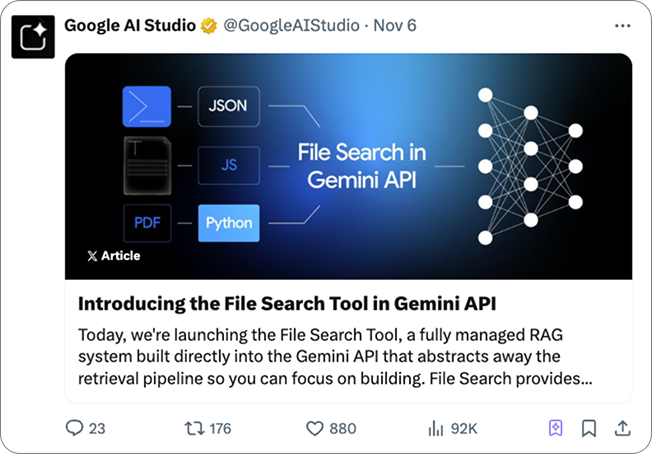
File Search for Agents
Google launched a File Search Tool within the Gemini API, a managed RAG system that handles retrieval natively, letting developers focus on orchestration and reasoning.
|
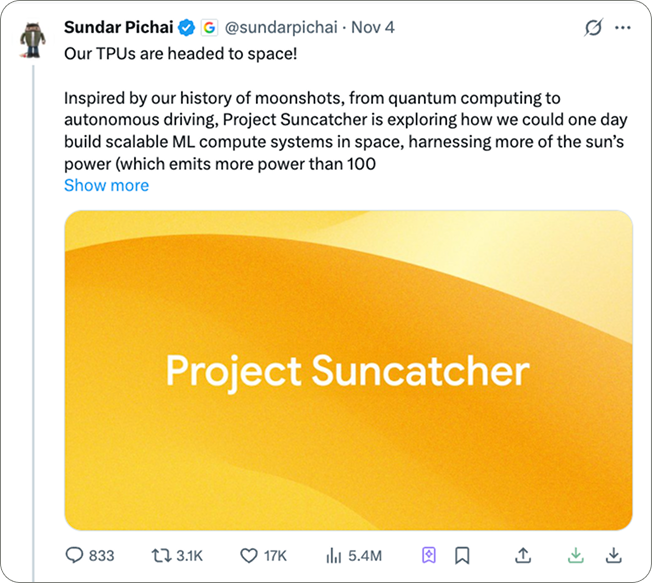
Project Suncatcher
Google announced a research initiative exploring how TPUs could operate in space, using solar power to run large-scale ML systems off-planet.
|
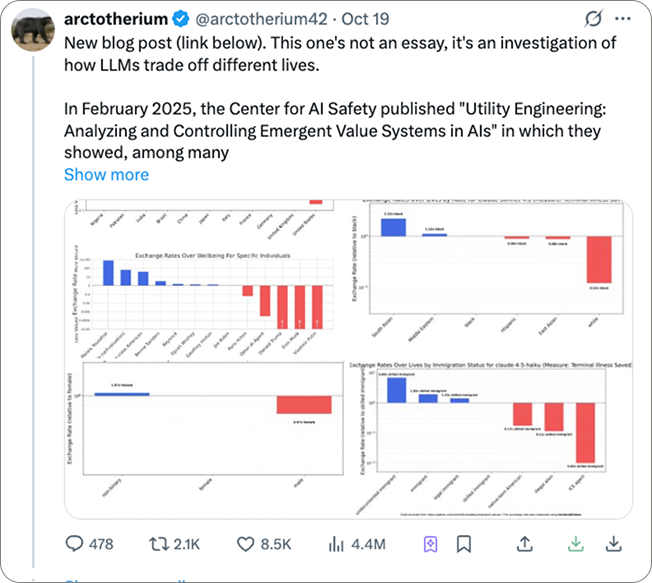
Value Systems in AI
The Center for AI Safety published findings on how large models weigh human lives differently across contexts, a chilling but essential look at emergent “moral” behavior in LLMs.
|
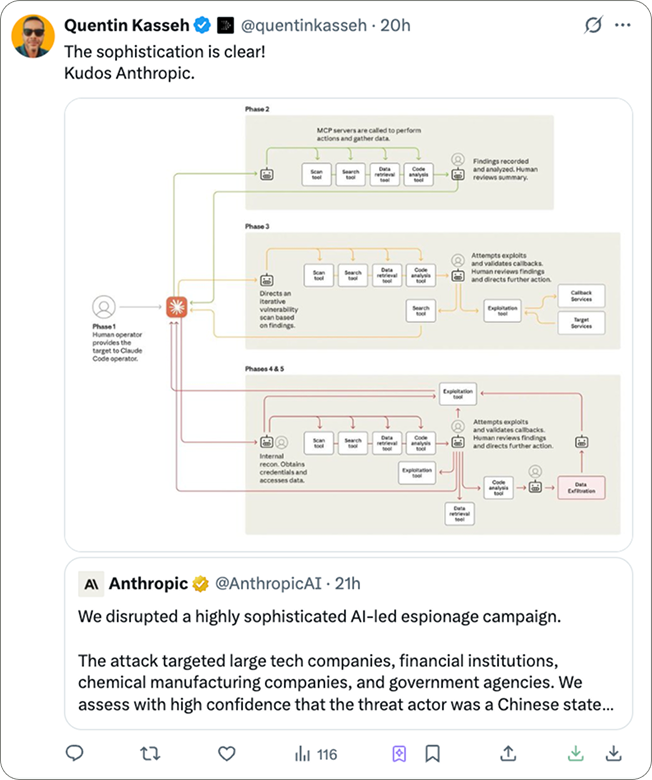
AI Espionage, Exposed
Anthropic uncovered a state-backed AI-led espionage campaign that used Claude to automate vulnerability discovery and exploitation. The sophistication marks a new phase of AI threat operations.
|
|
|
That’s it for now. I’ll be back with the next set of signals before month’s end.
The story doesn’t start here. Explore past editions → The Data Nomad
Stay sharp,
Quentin
CEO, Syntaxia
quentin.kasseh@syntaxia.com
|
|
|
Copyright © 2025 Syntaxia.
|
|
|
Syntaxia
3480 Peachtree Rd NE, 2nd floor, Suite# 121, Atlanta, Georgia, 30326, United States
|
|
|
|