|
|
EDITION #18 DECEMBER 2025
|
|
|
Hey there,
This month, several fault lines became visible. Agentic AI met the limits of legacy data, while new rules began taking shape in boardrooms and government halls. For builders, the signals are clear: governance matters, agility decides outcomes, and coherent data is becoming a strategic advantage.
Let’s break it down.
|
|
|
The White House vs. The States: A Federal Preemption Push on AI Regulation
|
What happened:
On December 11, 2025, a new Executive Order was issued with the stated goal of eliminating state-level barriers to a unified national AI policy. It argues that a "patchwork of 50 different regulatory regimes" stifles innovation, particularly for startups, and takes specific aim at state laws that might compel AI models to alter "truthful outputs". The order directs the establishment of an AI Litigation Task Force to challenge state laws deemed inconsistent and tasks agencies with evaluating existing statutes.
The breakdown:
This is a direct shot across the bow of state-led AI regulation, like Colorado's algorithmic discrimination law. The administration is leveraging federal authority and the threat of withholding grant funding to force a shift toward a single, "minimally burdensome" national standard. It frames the issue as a critical race for global AI supremacy, where fragmented rules are a national security liability.
Why it’s relevant:
For any company deploying AI across state lines, the compliance landscape just entered a period of high uncertainty. Legal challenges are imminent. Your governance strategy must now be agile enough to adapt to a potentially volatile regulatory environment, where federal preemption could suddenly nullify state-level compliance investments. This order makes a national AI law more likely, but the interim will be messy.
|
IBM Bets Big on Real-Time with Confluent Acquisition
|
What happened:
IBM announced an agreement to acquire Confluent, the leader in Apache Kafka-based data streaming, for $31 per share. The stated goal is to fold Confluent's capabilities into IBM's Data and Automation portfolio to create a "smart data platform" for generative and agentic AI.
The breakdown:
This is a massive, vertical consolidation play: IBM is acquiring the central nervous system for real-time data in the modern enterprise. The move positions IBM to offer a unified stack from event ingestion to AI-driven action, directly challenging cloud hyperscalers' native services and standalone streaming vendors.
Why it’s relevant:
The era of batch-only AI is over. Agentic systems that plan and act require a live pulse of business data. This acquisition validates that real-time streaming is now a foundational, non-negotiable layer for competitive AI. For architects, it strengthens the case for an event-driven backbone, but also invites scrutiny on vendor lock-in versus best-of-breed flexibility.
|
Agentic DevOps: Microsoft Formalizes the Shift from "What" to "Who"
|
What happened:
Microsoft renamed its "Accelerate Developer Productivity with Microsoft Azure" partner specialization to "Agentic DevOps with Microsoft Azure and GitHub". This wasn't a cosmetic change; it came with updated performance requirements explicitly tied to products like GitHub Copilot, Microsoft Dev Box, and Azure's AI infrastructure.
The breakdown:
Microsoft is institutionalizing the next phase of DevOps evolution. The focus is no longer just on automating what gets built (CI/CD pipelines) but on empowering and governing who builds it—developers augmented by AI agents. The specialization now measures success through the consumption of agent-enabling platforms.
Why it’s relevant:
This is a leading indicator for where all enterprise DevOps is heading. Your platform engineering roadmap must now explicitly account for AI agents as primary users. It’s about providing secure, governed tool access and context (see: Model Context Protocol) for AI co-engineers, not just human developers. The "Agentic DevOps" title will soon be on job descriptions near you.
|
Dremio Survey: The Agentic Ambition Gap is a Data Gap
|
What happened:
Dremio's 2026 State of the Data Lakehouse & AI report found that 65% of organizations rank agentic analytics and AI-driven decision-making as a top priority for the coming year. However, 70% cite siloed data and weak governance as their biggest obstacle.
The breakdown:
The survey exposes the core contradiction of enterprise AI. Ambition is soaring, but foundation is crumbling. Organizations want autonomous AI agents to make decisions, yet those agents will fail if they operate on fragmented, low-trust data. The report identifies the open lakehouse as the architectural response, aiming to unify data for agentic consumption.
Why it’s relevant:
This is the most concise diagnosis of the 2026 challenge. You cannot buy an agentic future off the shelf; you must build it on a coherent data foundation. Initiatives focused on data products, semantic layers (like the Open Semantic Interchange), and unified governance are no longer just IT projects, they are the critical path to realizing AI ROI.
|
|
|
The Rise of the AI Data Firewall
|
This month, a clear pattern emerged: as AI agents move from concept to production, the industry is rushing to build the guardrails they desperately need. We're witnessing the birth of the AI Data Firewall.
Consider the evidence: Couchbase launched AI Services with governance "guardrails" to verify agent actions against business rules. Striim introduced Validata to provide timestamped proof of data integrity for AI pipelines. Immuta's latest update focuses on policy-driven access controls for AI-scale data consumption. The throughline is enforcement.
These tools are solving for a new reality: when AI agents act on your behalf, they consume data and trigger actions at machine speed. A human-in-the-loop is not a scalable safety mechanism. The firewall must be automated, baked into the data layer, and capable of real-time policy execution, blocking a harmful prompt, filtering PII from an agent's context, or preventing an order placement based on stale inventory data.
This shifts the governance conversation from retrospective audits to pre-emptive control. The question for data leaders is no longer "Do we have a policy?" but "Is our policy enforced at every point where an agent touches data?". The companies that get this right will deploy AI agents faster and with exponentially more confidence. Those that don't will face amplified risks, where a single agent error, powered by bad data, can cascade at the speed of an API call.
At Syntaxia, we see this as the logical evolution of data governance. We're helping clients implement these guardrail layers not as stifling bureaucracy, but as the essential trust fabric that allows agentic automation to scale safely. It's the unsexy plumbing that makes the futuristic AI house habitable.
|
|
|
Agents as a Force Multiplier
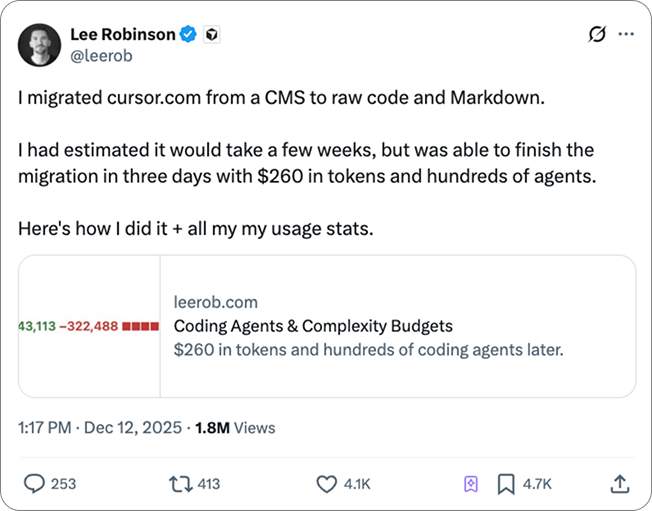
Lee Robinson migrated an entire site from a CMS to raw Markdown in three days using hundreds of coding agents, a concrete example of how agents compress complex work when guided well.
|
Claude Comes to Slack
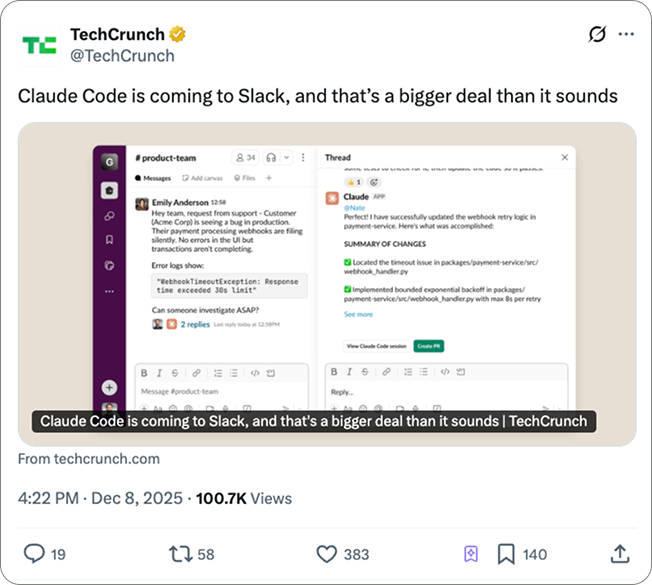
Anthropic is bringing Claude Code directly into Slack, pushing coding agents closer to where real operational work already happens.
|
Model Taste, Not Just Benchmarks
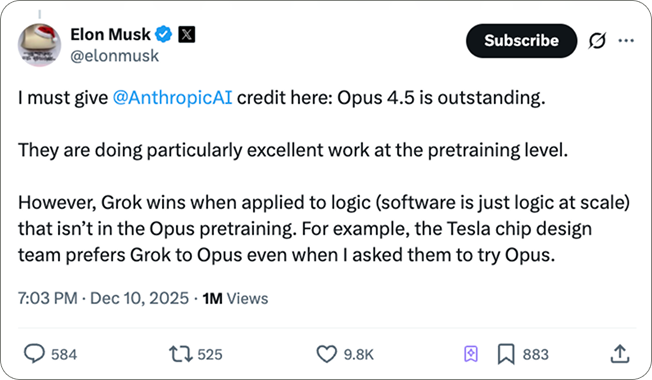
Elon Musk praised Opus 4.5’s pretraining while noting that Grok performs better for applied logic inside Tesla, a reminder that model choice is increasingly domain-specific.
|
Ads Inside the Narrative
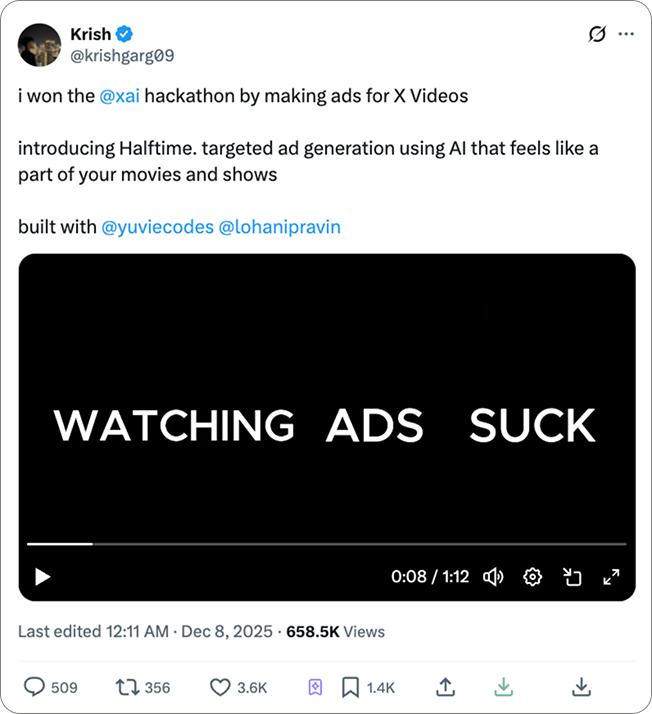
An xAI hackathon winner built AI-generated ads that blend directly into movies and shows, hinting at a future where advertising becomes contextual, dynamic, and almost invisible.
|
|
|
That’s it for now. I’ll be back with the next set of signals before month’s end.
The story doesn’t start here. Explore past editions → The Data Nomad
Stay sharp,
Quentin
CEO, Syntaxia
quentin.kasseh@syntaxia.com
|
|
|
Copyright © 2025 Syntaxia.
|
|
|
Syntaxia
3480 Peachtree Rd NE, 2nd floor, Suite# 121, Atlanta, Georgia, 30326, United States
|
|
|
|